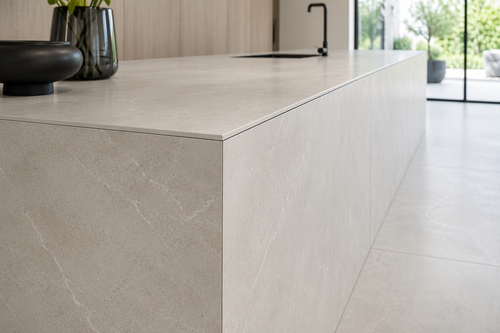




Miter cut instead of tile rail

FliesWerk manufactures miter cuts for clean outer corners without visible rails – for tiles and natural stone up to 160 × 320 cm. From the exact measurement to the 45-degree cut to the finished joint, everything comes from a single source.

We only cut materials that we also install ourselves – from the individual shower niche to the large-format clad wall. We directly handle the necessary coordination with plumbing, electrical, and carpentry.
Request project

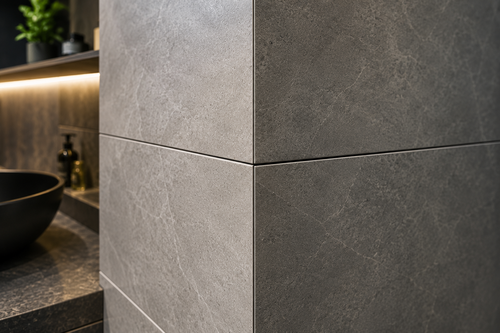
Nahaufnahme einer Gehrungsnaht: Die Spitze der Fliesenkante läuft dünn aus und bildet eine schmale Fuge.

What is a miter cut?

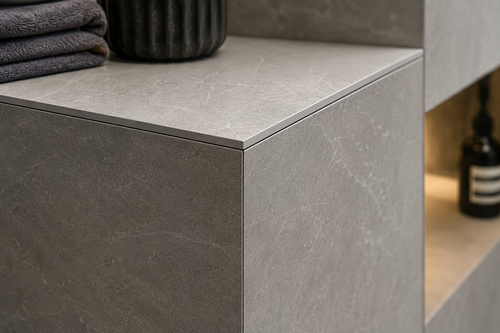
In a miter cut, the backs of two tiles or natural stone slabs are cut at a 45-degree angle. At the outer corner, they meet and form a clean 90-degree edge – without visible metal or plastic profile.

What matters here:

  • Do not cut to the tip: About one millimeter of material remains at the visible edge.
  • Protect the edge: This way, the glaze chips less quickly when bumped.
  • Hand finish: The remaining burr is cleaned up neatly.

This creates a precise outer corner with a narrow joint and a continuous tile look.

Außenecke einer Wandfliese ohne Profil, die beiden Platten stoßen auf Gehrung aneinander.

This is how we cut the miter

To ensure the corner fits perfectly at the end, we do not simply work with 45 degrees as planned, but with the actual angle on site.

  • Measure angle: Each corner is measured precisely before cutting.
  • Wet cutting: The diamond blade ensures a clean cut with water cooling without frayed edges.
  • Full surface installation: The miter is embedded without voids to keep the delicate edge stable.
  • Clean grouting: The narrow joint of about 1–2 mm is executed to match the surface.

Which material can handle a miter joint

Fine stoneware, glazed ceramics, and many natural stones can be cut at a miter joint. The decisive factors are thickness, hardness, and structure of the material.

  • Fine stoneware & ceramics: usually well suited. For non-through-colored tiles, the light cut edge may become visible – we can adjust this color-wise.
  • Natural stone: generally possible, for soft or heavily veined varieties we check a leftover piece beforehand.
  • Textured surfaces: only conditionally suitable, as a uniform seam does not form at the corner.
  • Mosaic: not suitable for miter cuts. Here we finish with a continuous plate or a profile.

Whether a miter joint makes sense, we always check with the specific material.

Gefliester Wandvorsprung mit umlaufender Kante ohne Metall- oder Kunststoffprofil.

Miter or rail – when we recommend what

A miter is not always the best solution. In heavily stressed corners, with thin material or working substrates, a stainless steel profile can be more robust and easier to repair.

For large formats, however, there are many reasons in favor of the miter: The surface remains calm and is not interrupted by a visible profile. Where profiles are more sensible, we implement these cleanly as well. What ultimately fits, we decide based on material, installation location, and stress.

Where we cut miters

Most miters do not occur on the large wall surface, but on small components with many corners – this is where angle errors accumulate the fastest.

Shower niches and niche floors

In a shower niche, up to twelve edges meet. The outer edges are mitered, the inner corners are elastically grouted, and the niche floor has a slight slope towards the shower side. Below lies the composite sealing according to DIN 18534 – part of every bath renovation with us.

Window reveals

Reveals are almost never right-angled and often taper towards the frame. We measure each reveal individually and cut the miter to the measured angle so that the edge remains the same width throughout its depth.

Pretexts and installation shafts

Wall installations and shafts bring several outer corners per bathroom that are visibly close together. Because the miter joint meets drywall there, we check beforehand whether the cladding at the edge is sufficiently rigid – a yielding corner pushes the seam apart.

External corners for large formats

For panels up to 160 × 320 cm, a single miter joint runs continuously over three meters. It is applied by two people, as the panel cannot be shifted after pressing; the edge is checked for alignment over its full length. More about these formats on the page for large format tiles.

Fireplace surrounds and wall claddings

On a natural stone fireplace cladding, the miter joint runs the full height of the surround. To ensure the grain continues around the corner, both panels must come from the same block – this is determined at the time of purchase, not at the cutting location.

Bases, Steps and Platforms

At steps and platforms, the tread and riser meet at a heavily loaded edge. We combine the miter there with a narrow bevel on the tread edge so that the tip does not remain sharp. Other possible designs are shown on the page for Edge Processing.

Process of your project at FliesWerk

Weiße Zahl 1 in einem gefüllten dunkelblauen Kreis

Request

You describe the project, material, and the places where corners remain visible.
Weiße Zahl 2 in einem gefüllten dunkelblauen Kreis

Measurement on site

We measure the actual angles of all outer corners, reveals, and connections and create the cutting list for this.
Weiße Zahl 3 in einem gefüllten dunkelblauen Kreis

Sample and Offer

On the leftover piece, we check the chip color and edge behavior; the offer states the miter per running meter, separated from material and installation.
Weiße Zahl 4 in einem gefüllten dunkelblauen Kreis

Cutting

The panels are cut wet to the measured angle, then we manually finish each visible edge.
Weiße Zahl 5 in einem gefüllten dunkelblauen Kreis

Laying and Grouting

We set the corners, grout the seams, and check each edge for alignment and voids.

A corner planned without a rail?

Send us material, format, and a photo of the spot – we will let you know if the miter works there.

Request project

Miter cuts in Saarland, Luxembourg and the Greater Region

From Nalbach, we visit construction sites throughout Saarland, Luxembourg and the adjacent Greater Region; Saarlouis and Saarbrücken are half an hour away, and the border towns in Luxembourg are about an hour away. Measurement, cutting and installation are all handled in one hand – we work without subcontractors.

With architects and commercial clients, we clarify the edge formation during the planning phase, as they influence niche dimensions and material thicknesses. For private builders, it usually starts with a site visit where we go through every corner and determine which runs at an angle and which gets a profile.

Frequently Asked Questions about Miter Cuts

What does a miter cut cost?

The miter is charged per running meter of edge, separate from material and installation. The price depends on slab thickness, material, and accessibility – a 12 mm thick natural stone requires significantly more cutting and finishing time than a 6 mm thin wall tile. We list the edge work in the offer as a separate item so that it remains comparable to an execution with profiles.

Is a miter edge sensitive to impact?

A cleanly executed miter holds up in everyday use, but is more sensitive than a metal profile. Two things are crucial: The seam must be fully seated in the adhesive, and there must be a remainder of material at the visible edge – hollow or sharply tapering corners can break off. Therefore, we recommend a profile at places that regularly experience impact.

Miter cut, Jolly cut, 45-degree cut – are they the same?

Yes, all three terms refer to the same cut at the tile edge. “Jolly” is the commonly used shorthand in the trade, named after the edge profile of the same name. If one of these terms appears in an offer, the same service is meant.

Can a miter joint be created afterwards?

No, a miter joint is not possible on tiles that have already been laid – the cut starts at the back and requires the loose tile. Anyone who wants an existing corner without a profile must remove the affected tiles; it is usually more sensible to combine this with the next bath renovation or wall cladding.

How long does the edge work take additionally?

The mitering extends the installation time because each edge is measured, cut, and finished individually. How much time is added depends mainly on the number of corners – we specify the effort in the offer and coordinate it with the other trades. Drying times for sealing and adhesive continue independently of this.

Which tiles are not suitable for a miter joint?

Not suitable are mosaic, very thin slabs under 6 mm and materials with a structured or broken surface. In non-through-colored porcelain stoneware, the light chip becomes visible at the edge – here we color the edge or change the edge execution. Whether a material is suitable is checked on the leftover piece before the order is placed.